

Like most people, I constantly feel like I don't have enough time to do all the things I want to do.
How can we get more done in the same amount of time? The solution seems simple: be more productive with your time. But how?
Over the years, I've watched a lot of productivity videos of self-help books like Atomic Habits (would highly recommend btw) and Deep Work. I've experimented with a lot of strategies for becoming more productive, and I'll talk about how I get work done most efficiently.
How I maximize productivity
This is my battle-tested strategy (influenced by many productivity books and videos) that I've kept with me throughout my later years of high school til now.
To-do lists
At a high level, I keep track of a list of to-do's, so I don't forget what tasks I have to work on in the next weeks. I've experimented with multiple formats, but I've found that the simplest formats are the best. I currently have a note tab I keep open all the time on my browser, and jot down all the tasks I have in a list.
If you're looking for a to-do list app, I would also recommend Todoist. It has an intuitive interface, and lets you add deadlines and tags to tasks easily with natural language. Checking off tasks in to-do lists is always satisfying, although I find to-do lists take a little more work to maintain.
Time blocking
For some people, blocking out every hour on a calendar works well for them. I've tried it, and it doesn't quite work for me. I find it's too easy to get off-track and it throws me off.
What I prefer instead is ordering the items I have for each day, and setting an approximate duration for the task. I can also pre-plan several days in advance, so I know I have enough time allocated for each task.
For example, I might have:
- CS assignment ~2h
- Study for math quiz ~1h
- Cook lunch
- Go to gym ~1h
Important things I consider while planning:
- I know I only have a limited amount of energy where I can focus deeply, so I can't schedule more than ~2 tasks/day that require deep work. (read Deep Work by Cal Newport)
- I work/learn best in the morning, so I make sure to schedule high priority tasks then. On the other hand, I can't focus well after a long day of classes, so I'll hit the gym or meal prep in the evenings.
- While I've gotten better at predicting how long I'll take for each task, things always take a bit longer than expected. To balance this, I always plan less and leave buffer room during the day.
Getting work done
Getting work done in shorter, consecutive blocks of time is a lot more effective than getting work done in longer, but possibly more distracted, blocks of time. That's the power of deep work.
The secret weapon for getting things done is the ✨timer✨. My timer app has a pre-set timer for almost every 5-minute interval. It's one of the most effective strategies for actually getting work done.
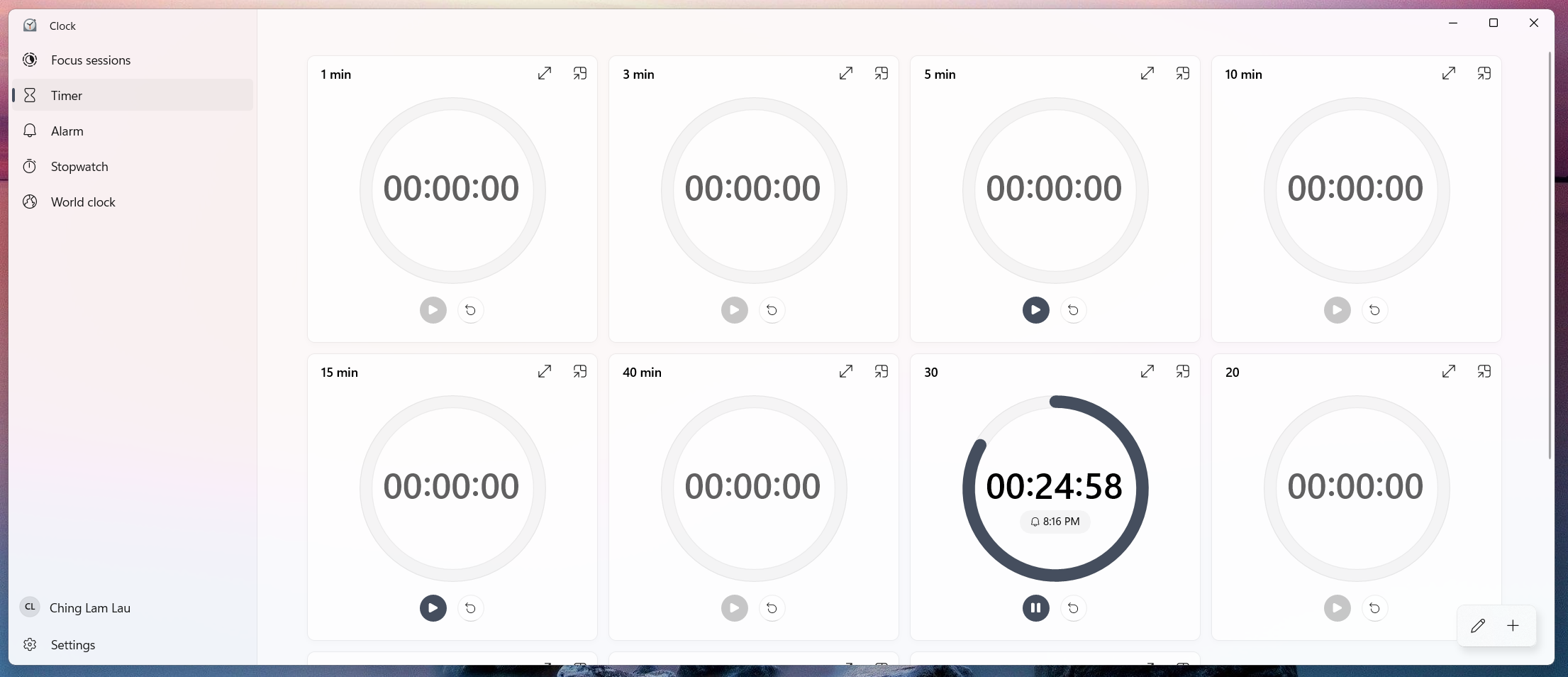 My handy set of timers.
Before I start a task, I'll think about approximately how much time I'll take for a task and set a timer. Knowing that there's a timer counting down means that there's an artificial deadline for me to get the task at hand done. While the timer is set, I will focus solely on my current task and won't switch contexts to work on other tasks. I'll also get rid of distractions in my environment, like any distracting tabs or my phone.
The second benefit for a timer is that I have an idea of how long I took to complete a task. This helps inform future me about how much time I'll likely need to spend on a particular type of task, so I can time-block more effectively.
Pro tip: if you think you'll get a task done in an hour, set the timer for 40 minutes. It'll make you work faster and more efficiently. Additionally, I don't set any timers for longer than 50 minutes. After 50 minutes, I'll reassess how much energy I still have, as well as how much more time and energy I need for a task.
The most important part to getting work done efficiently is knowing myself. That means knowing when I work best (mornings, nights), how I work best (in my room, with a timer), and when I'm too tired to get anything done. Unless I have a deadline coming up, if I'm too tired to work effectively, I'll just stop working and recharge for later.
Finally, if you're a big procrastinator (like I was), then getting started might be the hardest part. I always try to break down the big, daunting task down into smaller, actionable tasks so that it sounds a lot less scary to start.
On social media
For many people, the biggest blocker to productivity is social media. I've had my fair share of struggles with social media addiction, but I've learned to use it more intentionally so I can benefit from these apps (staying in touch with friends and classmates) instead of vice versa (the apps taking all my attention).
On my phone, ScreenZen prevents me from accessing social media apps easily, by adding a 10-second load time before giving me 7 minutes of access time, for up to 3 times a day. This has been super effective in stopping me from mindlessly clicking on social media apps.
I use my laptop for messaging others, and I've installed a browser extension to remove Instagram's feed and reels.
Conclusion
With the right system in place, it becomes a lot easier to get work done, even on days where you're tired or unmotivated. If any of this sounds helpful, feel free to steal it for yourself :) Just keep in mind that what works for me will not work for everyone, so an important part to becoming more productive is figuring out what works for yourself.